
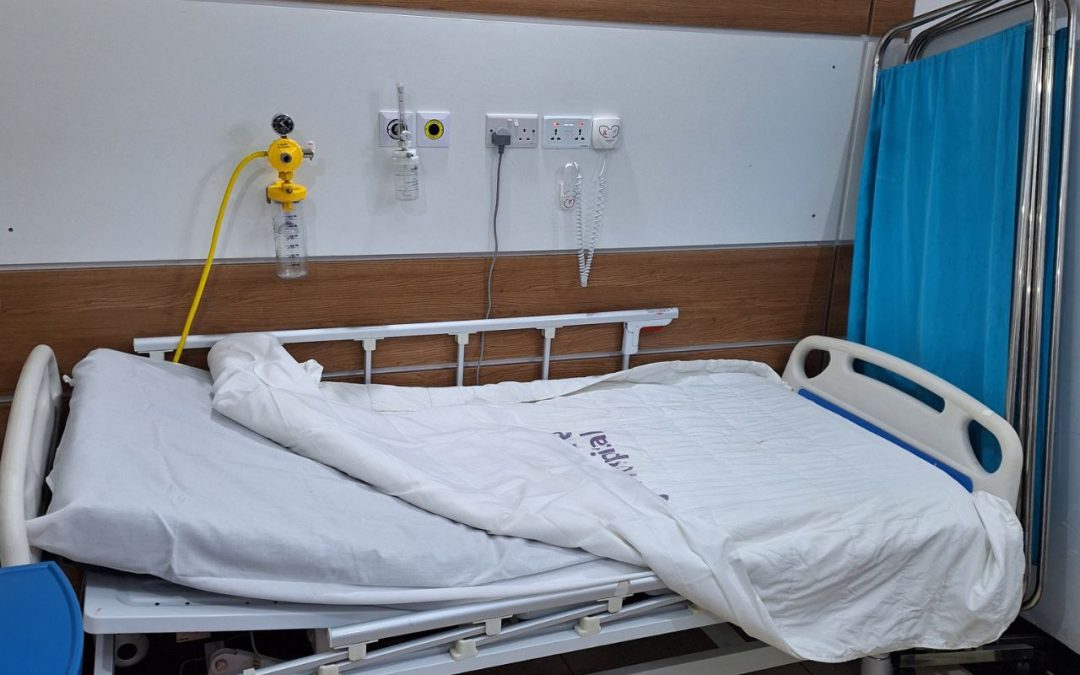
If you ask me why I went back to the hospital my mother died, I wouldn’t be able to tell you. Maybe I wanted to see if they would recognise me (they didn’t) or if I would feel different (I don’t). So much had changed in my life, but everything there remained the same. And it was all coming back to me. This was where my friends held my pieces as I disintegrated, that bench over there was where my Aunt R—, and my cousins M—, S— and N— bawled their eyes out keening through the stations of their grief, and here, where the hearse later parked, is where the Imam called me, at 1-something-AM, asking for the body to be transferred back home that night. I wanted to tell him, Fuck you. But mother would have disapproved, always giving people a longer rope than they deserved. It struck me how much, even in her death, how much hold she still has over me.
When I was a child, growing up in Shirere, Kakamega, my father one day brought home a large painting on plastic and hung it on the wall, just above our Panasonic TV, making it—the TV, not the painting—look even smaller. The picture on there was of a wide-open sky, with the sun hanging lazily as if waiting for his friends, the moon and stars. Or maybe it was no sun, maybe it was God’s light. Though it had a certain poignancy, I thought, it was . . . cheap. And it pissed me off with its largesse. There was a large stairway from the bottom leading past into the light, and above it, written, “Stairway to Heaven.” Of course it was no heaven at all. And if it was, considering how much my mother hated stairs, she’d have taken the escalator to hell; that’s how much she hated stairs.
All this, all this I can remember—but what I cannot forget is the words the Asian accountant told my friend N— and I, that they don’t take collateral, only cash, and that would have been fine, but then she added, “…even from our people, we don’t take collateral.” Our people? Was that supposed to be comforting? N— gave me a knowing eye, and I can still see that eye, even right now as I stare at a mummified statue in the hospital lobby, my heart racing. That eye said, Fuck this. She did not like us; we did not like her. We were all Kenyan, but not exclusively. Hers had a hyphen, Kenyan-Asian, and that hyphen was both a metaphorical and literal distance.
I wanted to ask what she meant by that statement, but when she looked up, I could see in her eyes that none of that would have mattered to her. Instead, I tell N— how I’ve always been suspicious of Indians and the undercurrent that runs beneath the river of their soul, of how well off they were, and how they thought themselves second in command after the white man, following their Master’s will. They were not at all cold, not really, but they had been taught how to tolerate the blacks and perhaps toss them a greeting in passing with forked tongues. But nothing more.
I could go on, and I will: Is it not true that Mahatma Gandhi—deified for his human rights, but he could so easily have been demonised—lived in apartheid South Africa from 1893 to 1914 and yet he viewed black people as one step above animals, describing them as “savages”, “dirty” and “wild”? There were some scandals and “sexual experiments” involving young girls, too, including sleeping naked with his 19-year-old grandniece, Manu Gandhi, to test his vow of celibacy. You and I don’t know about these things until we do, in which case we will also be put out of sight. Or silenced.
People say that there are always signs. I’d heard stories. That when a person is about to die, they go into terminal lucidity. A newfound strength. They might ask for food. Or ask to go home, declaring themselves Healed. Some say that their whole life flashes before their eyes. A clarity of mind, the living and the dead passing each other as if along a corridor. I disagree. Maybe it was true for them, but it wasn’t true for me. It was a usual evening, a drab Thursday, the smell of hospital antiseptic, the sweat in my armpits, the coffee on the doctor’s breath, the difficulty in pronouncing Shree Swaminarayan. The doctor was short, and he spoke in bursts, like a misfiring gun, his voice dry, and he would not look into my eyes. What was there to see in my eyes anyway?
The odds were not in our favour, he said, in his version of the events, presenting a minor masterpiece of exactness and economy. We don’t know if the patient will respond to the medication. We don’t know how much the cancer has eaten. We don’t know if she will make it through. You know what I mean?
I knew.
But if you ask me how, I wouldn’t be able to tell you.
I knew a man once who said, “Death smiles at us all. All a man can do is smile back.” Death had winked at Ma in the hospital, and she smiled. She was still here, but she wasn’t. Her body twisted by death in a way that life never can. Ah, life. It was funny how life hides so much; how naked the end of it makes you look, how life is short but time is long, how almost indecent, the ICU machine beeping long after the patient had died, like a hungry ghost.
“An honoured guest,” I read from a book by Joy Williams. To live was like being an honoured guest. Then you were no longer an honoured guest.



Very sorry about the racism and the loss of your mother, Eddy.
Shukran, Marion.