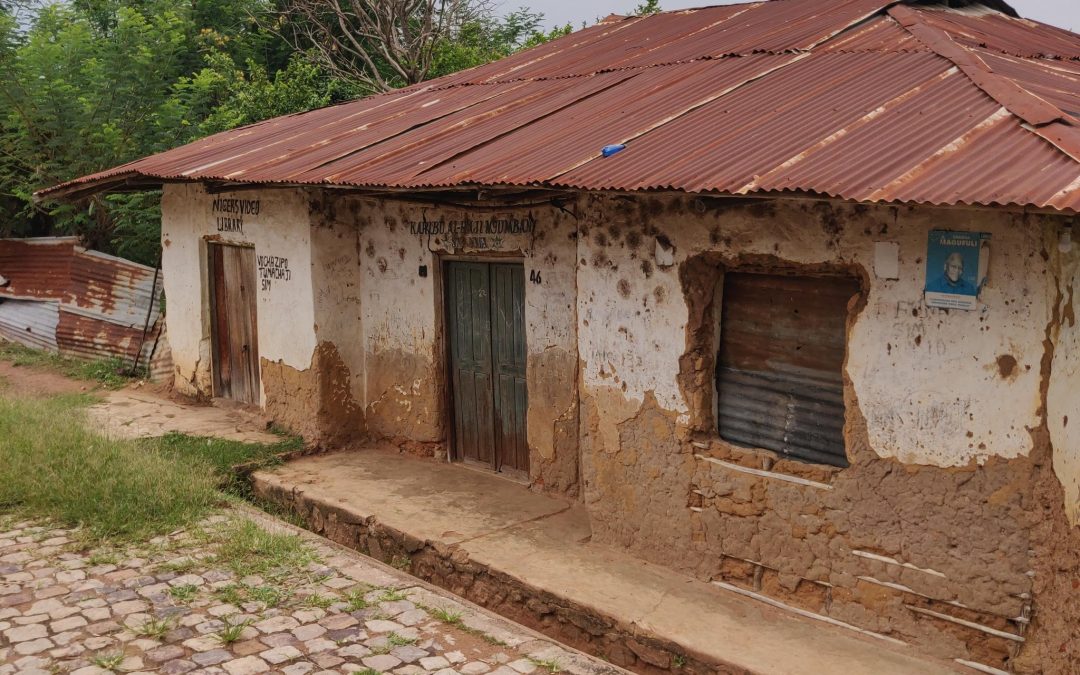
There was a shylock who ran the economy of the village, and if your parents needed quick cash, they’d swap something in the house for it. We called him Muindi Mweusi because those days only Indians had money. There was always a calculated correctness in him that I admired. He had the easy charm that shysters have as a matter of course. Yet we never paid back, because Africans don’t pay back.
If we didn’t go to the shylock, we would open a line of credit at the kiosk. Sukari. Unga. Mandazi. It would all be written down, and the shopkeeper would have a record of everyone’s debts and iniquities, as I imagine St Peter does at the pearly gates of heaven. I also imagine St Peter pointing to a sign at those heavenly gates written “Mbwa Kali!” —just in case someone tried to force their way inside.
Visitors would eddy into our homestead, and that means we would be eating good that day. Mapochopocho. We would be sent to the kiosk to exchange chupa ya soda, eating the ripened fruits of the Lantana Camara on the way. Soda baridi, we would chant. Soda madiaba. Fanta Orange, 2L. With the change that remains, we would buy the KSh 5 sachet of Juice Cola. 6g for 2L of juice. Guaranteed. You know how it is. We were better economists than our mothers, we thought. A mind, truly, is a terrible thing to waste.
The chickens would stroll around, not knowing they had a few hours to live, and we would be the sentry, tasked with the noble calling of standing guard to these feathered prisoners of war who were not to escape at any cost. At all costs. Someone would be sharpening the guilty knife against a stone, as we studied the chickens’ necks. This was back in the day. Jeff Koinanage had just left CNN then I think, and we would make fun of his curl kit when he came on TV, that perhaps alirambwa na paka jini. Children would be blowing barutis the whole night and no one would dink and jink for cover thinking it is a stray bullet, we can’t try that nonsense today, not with this trigger-happy gava in situ.
Nobody would touch mother’s fine china, the crystal glasses, the melamine plates. “Hii ni sahani ya wageni.” My mother had a gaze that could fall on you, heavy as an axe. Her motherhood dogma was simple: ‘the whisper is louder than the shout,’—she didn’t need to say much. She would look at you and cut you in half and you would feel the fear of God finding every pore in your body to get inside. We understood.
And to reinforce dominance, if you wronged her, or refused to do the dishes, or embarrassed her before wageni, she would ask for meal suggestions, listen intently, and discard all your options. “You will eat what I put before you.” The what? Ugali ya kusiaga na nzuu.
And I’d run into the bedroom, in protest, to mix the 6g of Juice Cola that was left.